From avoiding the community to rebuilding independence: One patient's rehabilitation journey on Tiptree ward
For people living with complex mental health needs, recovery is about much more than stabilising symptoms.
Many patients reach a point where they are clinically ready to move on from acute or secure services but still lack the confidence, practical skills or resilience needed to live independently in the community.
This is where specialist rehabilitation can make a significant difference.
On Tiptree ward, our specialist male rehabilitation service in Essex, our multidisciplinary team works together to help patients rebuild everyday skills, increase confidence and prepare for successful community living.
One recent patient journey demonstrates how personalised therapy interventions, sensory-based approaches and community rehabilitation can transform recovery.
Theo’s starting point
When Theo* was admitted to Tiptree ward, he had experienced many years of hospital care due to his complex mental health needs.
His presentation included severe anxiety and sensory processing difficulties. He feared leaving the hospital environment and avoided community settings altogether. His confidence was very low, and he was over-reliant on others with no sense of agency or autonomy.
The result was that for more than a year, he had been unable to attend important healthcare appointments, including dental and audiology services.
These challenges significantly affected both his level of engagement with others and readiness to explore life beyond hospital care.
A personalised rehabilitation programme
Rather than expecting Theo to immediately manage situations that felt overwhelming, the multidisciplinary team developed an individual rehabilitation plan focused on gradual, achievable progress.
Occupational therapists identified underlying sensory processing difficulties contributing to his anxiety and avoidance of community environments.
Working alongside nursing, psychology, psychiatry and the Sport and Exercise team, interventions included:
- Sensory-informed assessment
- Sensory-based interventions that support emotional regulation
- Anxiety management strategies
- Collaborative goal setting
- Graded exposure to community environments
- Structured shopping sessions
- Community rehabilitation
The Sport and Exercise team also helped Theo reconnect with an activity that had previously brought him enjoyment, as well as improve his overall physical health and sense of mastery.
Together they set a personal goal of once again completing football kick-ups, providing both motivation and a tangible measure of progress throughout rehabilitation.
Small steps leading to lasting change
Recovery often begins with small achievements.
For Theo it was carefully planned weekly community visits that initially focussed on him pushing a shopping trolley around a local supermarket and carrying his wallet on his person.
As his confidence increased, Theo gradually progressed to selecting items, using self-service checkouts and managing money independently.
These carefully paced experiences helped reduce anxiety while building practical skills that would support greater independence beyond hospital.
Alongside community rehabilitation, he also achieved his personal exercise goal of completing 12 football kick-ups, improving both his confidence and physical wellbeing, something he is very proud of!
Meaningful outcomes
By the end of his care on Tiptree ward, Theo had achieved significant improvements across multiple areas of daily life. These included:
Functional autonomy
- Shopping with minimal support
- Learning to use new technology, using self-service checkouts confidently
- Managing money independently
- Increased confidence navigating community environments
Access to healthcare
- He attended overdue dental appointments
- And audiology appointments
- His engagement improved with wider healthcare services
Physical wellbeing
- His strength and mobility improved significantly
- He participated in exercise more regularly
- He achieved his personal football goal
Psychological wellbeing
- Theo’s anxiety greatly reduced
- His confidence increased
- And improved self-management skills and greater self-awareness
Preparing people for successful discharge
Theo’s journey demonstrates how specialist rehabilitation addresses the practical barriers that can delay discharge, even after someone is clinically stable.
Through personalised occupational therapy, specialist sensory-based approaches, community rehabilitation and multidisciplinary support, patients can develop the confidence and everyday skills needed to access healthcare, participate in their communities and move towards more autonomous lives.
For commissioners and referrers, this means greater confidence that patients are not only ready to leave hospital but are better prepared to sustain their recovery once they do.
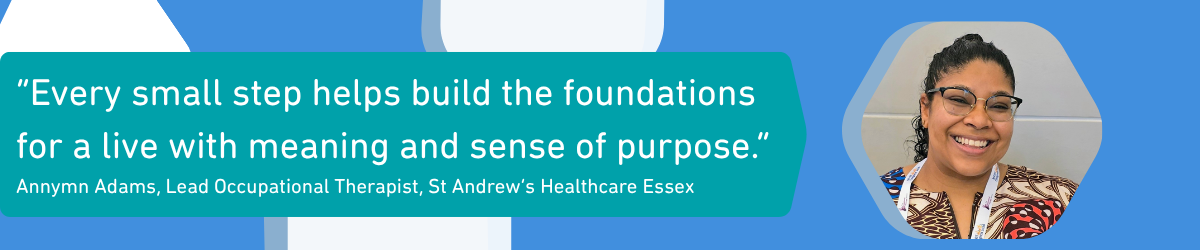
"Recovery isn't measured by how well someone copes on the ward. It's measured by how confidently they can engage with everyday life beyond hospital. Every small step helps build the foundations for a live with meaning and sense of purpose.” Annymn Adams, Lead Occupational Therapist, St Andrew's Healthcare Essex
If you are supporting someone whose recovery has progressed beyond acute or secure care but who you feel would benefit from specialist rehabilitation before returning to the community, our team would be happy to discuss whether Tiptree ward could help.
Call us: 0800 434 6690 or email: sah.admissions@nhs.net
*Patient name changed to protect anonymity.